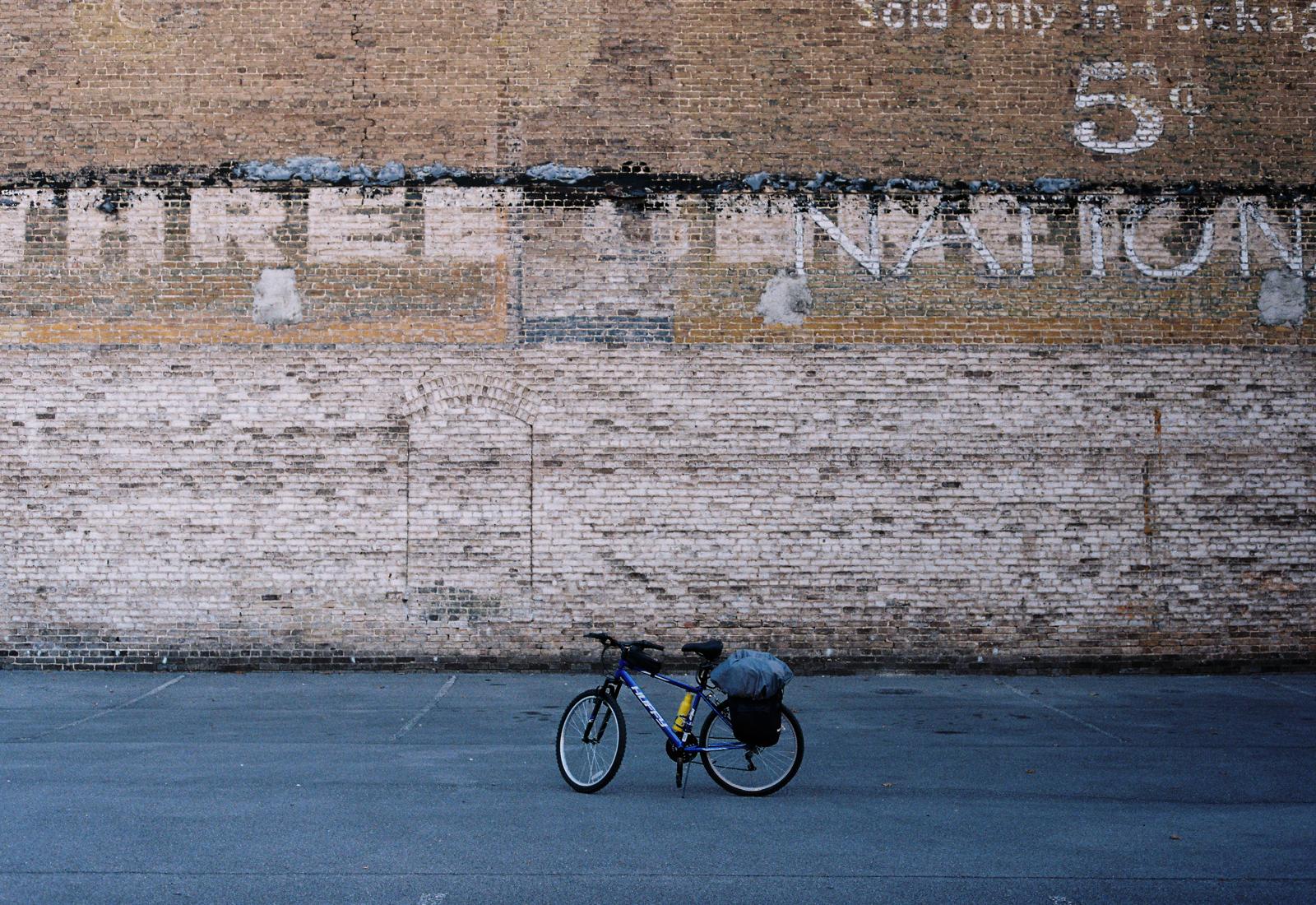
Getting a bike has perhaps been one of the most impulsive things I have done during my travels. Within the span of two full days, I went from marinating the vague and far-off idea of hypothetically getting my own two-wheeled steed, to stepping into a Walmart and acquiring the cheapest one. The very next day, I got a back rack placed, purchased saddle bags, got a small bag to carry my phone and view Maps on, and even bought one of those tiny repair kits with gadgets I had never before seen, let alone know how they need to be used. There was no going back from this. I had become a full-fledged biker.
Throughout all of that I was unsure on whether I was making the right choice. When first looking at bikes, I had even walked out of Walmart completely and decided to let the idea fester in the realm of possibilities for a little while longer. I would have to rethink my travel plans completely and take trains instead… Was I ready to give up on my idea to travel the U.S. from West to East using just Greyhound buses just like that? And what would I do with my bike once I entered Canada? It is too cold out there to cycle and every Canadian I have somewhat excitedly told about the bike has equally as excitedly shown enthusiasm, while making clear that there is very little cycling to do in winter (in the end, though, I have actually managed to do quite a bit of biking in Montreal). Every pros and cons list that drifted in my head leaned towards the negative… So how did I find myself back inside Walmart thirty minutes later, holding my new bright blue possession tightly and making my way to the register?
Well… it is as simple as this: after I had waited for twenty minutes on my bus to take me back to the hostel, it drove right past me without even giving me the opportunity to wave it down. By now, it was already dark out and it would take another twenty plus minutes for the next one to arrive. At that moment, a bike seemed, on all accounts, more reliable than both public transport and my legs could ever be. Somehow, this trumped the endless list of cons and I ended up shuffling my way back inside the big, impersonal and busy warehouse that Americans have grown to love and hate.
If that bus would have stopped where it needed to, I probably never would have gotten a bike at all. From that moment onwards, owning a bike has quite literally been an uphill battle. But it has also been a challenge that I have been willing to face, and one that has provided me with experiences I wouldn’t have missed for the world. By now, Huffy the bike has traveled with me from New Orleans to Montreal, making it my most loyal travel partner thus far, and although our journey together is nearing its end – I fondly look back to the memories we have made.
Going into Austin, all I knew about it was that it was not like the rest of Texas. Going into Texas, most of what I knew was that it was a deeply-rooted red state where people love their guns more than anything, wear cowboy hats, fashion leather boots and drive large pick-up trucks (a sweeping generalization, I know – there is more to Texas, I’m sure). A lot of this ended up being the case for Austin, too, but still I had to agree that there was something inherently different about this city. When looking at a map visualizing the margin of victory between Republicans and Democrats over the past couple of state and national elections, Austin stands out as a bright blue dot amongst a sea of red.
Who is Austin?
This city is known as the music city (live music, that is), prides itself for its diversity, values its infamous local breakfast tacos and unique waterholes, and embraces the inherently weird. In Austin, you can be yourself. Like in Portland, Keep Austin Weird is a tagline you can find on mugs, t-shirts, murals, and keychains and so surely, I thought, there must be truth to it. Being a bit different myself, I was curious to find out whether this flamboyant city would embrace someone like me too. And just how different to other major and supposedly unique cities would it truly be?
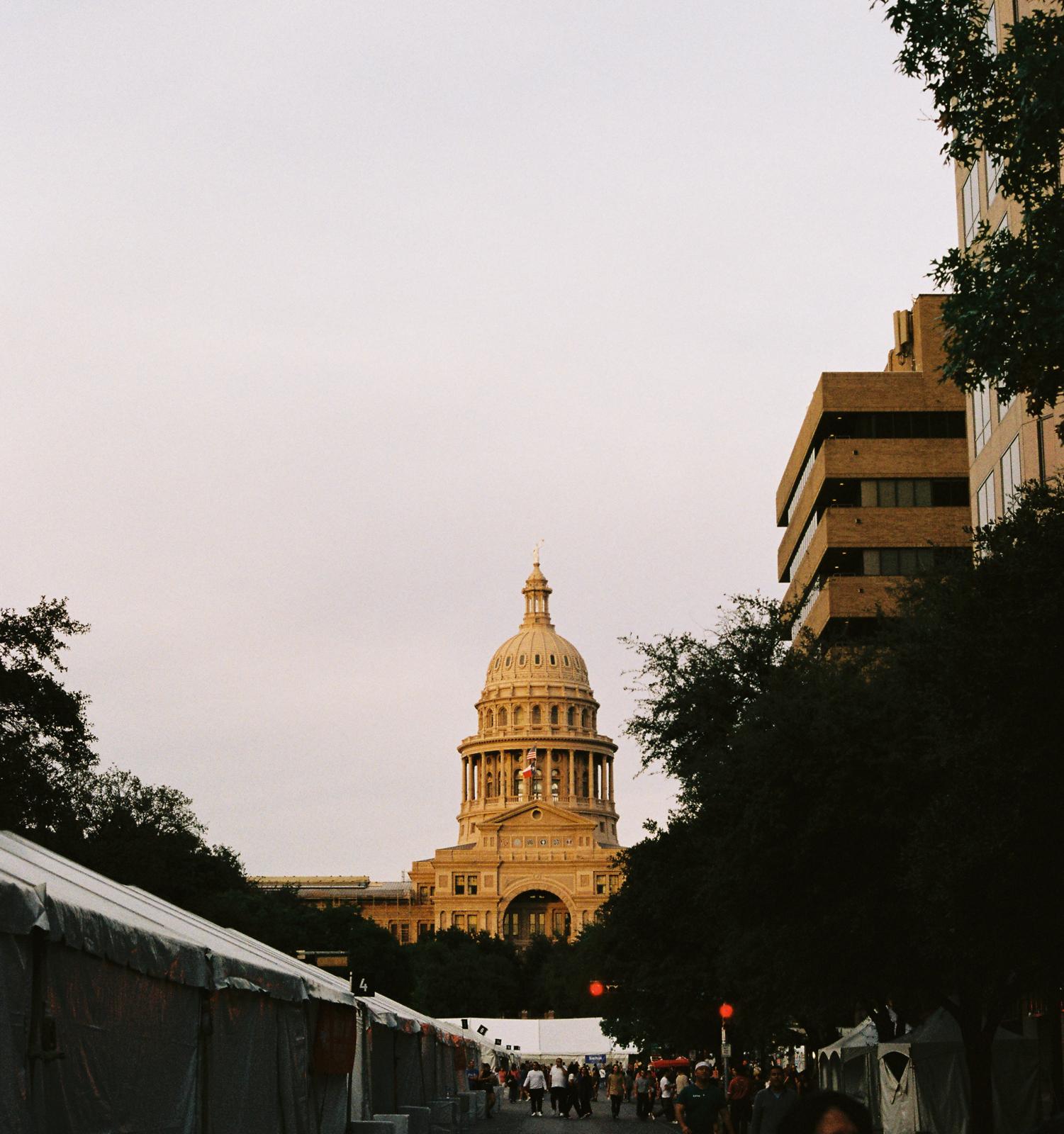
The Texan State Capitol jutting up towards the sky, legal restrictions on construction prevent this view from being obstructed.
In the end, I initially found much of the city to be similar to other places I had visited in the U.S., the linear course of 21st century politics and capitalist economics slowly chipping away at what had once made Austin stand out. An interstate highway now stood where diverse and historically bound neighborhoods had once existed and tech companies had come in to construct large skyscrapers obstructing your view of the sky. Over time, Austin’s natural pools were struggling to keep up from overuse and animals that had once called these places home were crippling in numbers. And a breakfast taco? You’d be hard pressed to find an affordable option. Simultaneously, rent prices continued to soar and the people who made Austin what it is are increasingly pushed away into adjacent neighborhoods – further and further from where the real weird happens.
Austin WeirdLingers On
Despite all this, there continues to be a beating heart in Austin, kept alive by those who stay and by those who are drawn by the story that this city has sold over the years. I was very fortunate to find myself right in the center of the ‘true and authentic’ Austin and during my week there, I almost felt as though I had stepped back in time into a world where hippies and freethinkers continued to thrive, where off the grid living near a wildlife sanctuary was still possible, and communal potlucks were often held.
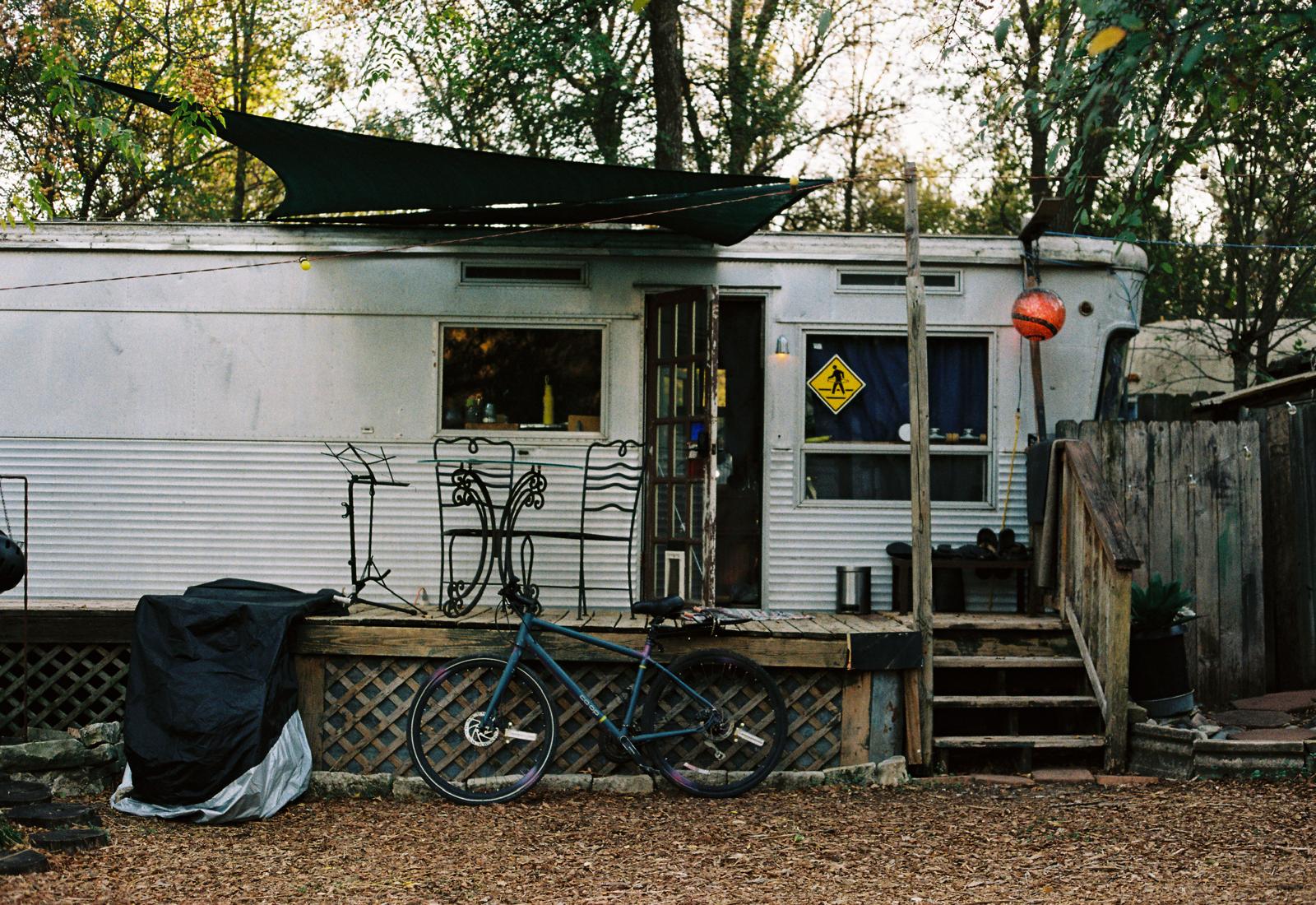
My temporary home in Austin, TX.
When finding myself at a local barn dance a few days into my stay in Austin (at the invitation of a friend I had made at a potluck a few days before), I talked to some people about my being in Austin as a Dutch person. We were standing in someone’s gorgeous and spacious backyard, a wooden stage erected in the far left corner from which country music drifted into the cool evening air. Around us, two tables were covered with home-made food, so many options that you could probably go back four times, fill up your plate to the rims, and still leave without having tried everything. I remember them looking at me in surprise, taking in our surroundings, and going “it took us sixteen years to find this place, and you stumbled upon it in a week!”. Ever since that moment, I decided to hold on to the uniqueness of what I had found, and concluded that the city of Austin seemed to carry within itself a multitude of dimensions.
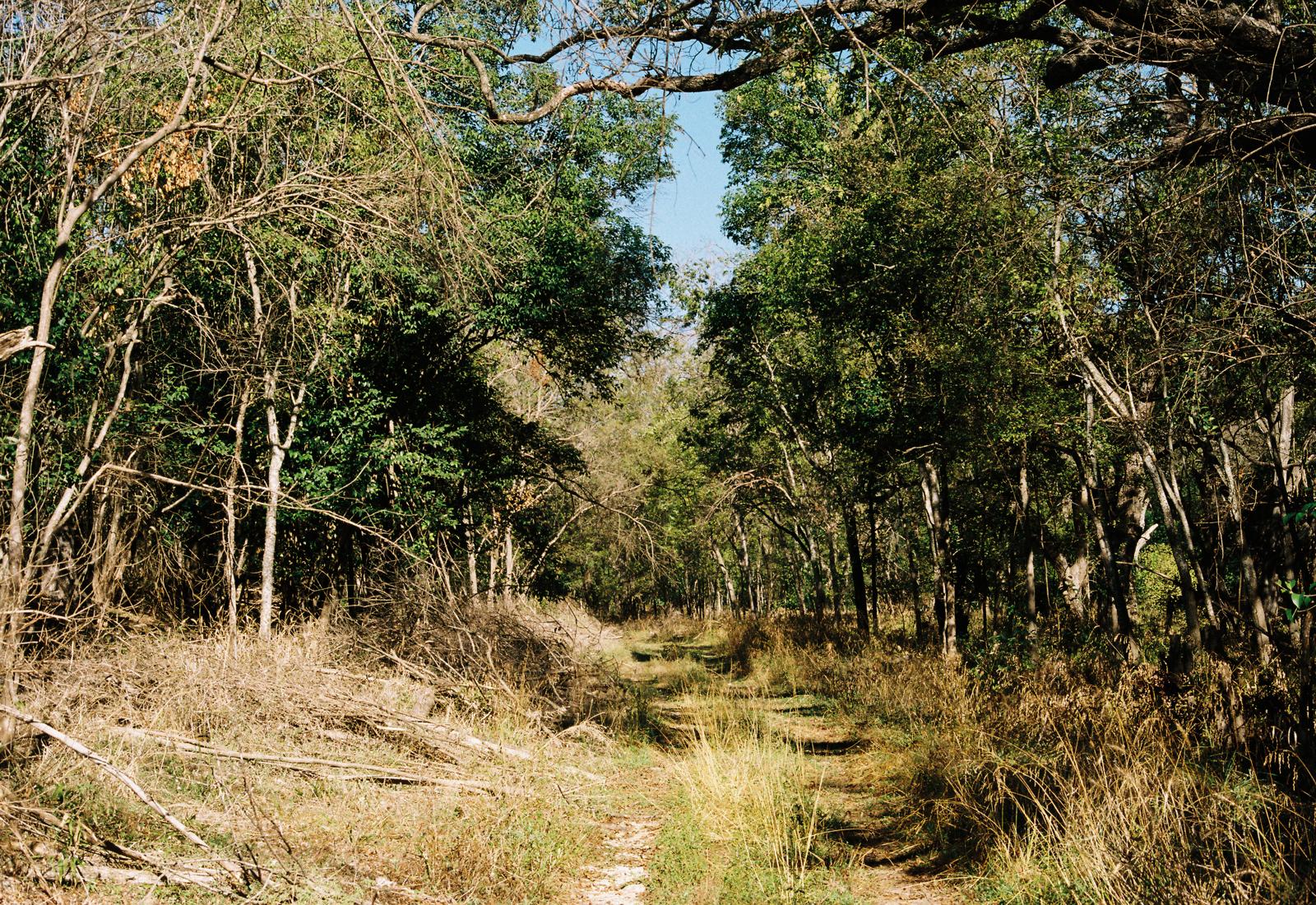
Austin’s character is what makes it so unique, and many people continue to be drawn by this. For a week, I house-sat and looked after two half-feral but loving cats at an eclectic campsite in a beautiful green enclave right off the South Congress Avenue (only in Austin, I thought to myself as I cycled from my forested homebase onto the busy road every afternoon). In the morning, I would be awoken by the sound of squirrels running amok from tree to tree, dropping nuts on my trailer’s roof, and I was even lucky enough to cross eyes with multiple deer. At night, I could hear the coyotes howling into the darkness as I feared for the life of my two cat-children who still hadn’t come inside (they’re okay). This campsite was engulfed with art and individuality. Here, old bed frames were constructed into lucious garden beds, the chicken coop built on the remains of an old shed, trailers and broken down cars turned into comfortable living conditions, and the one winding path running down the campsite paved with different colored orbs of glass that would glitter in the sunlight.
A swath of wildlife hosting deer, skunk, coyotes, butterflies, birds and more right off South Congress Avenue.
One of my neighbors was a young man, a philosophy major originally from Utah but with Greek descent, who hoped to one day permanently migrate to Austin. Every time I saw him, he wore a white cowboy hat, adjourned a pair of beautiful boots, fashioned plain jeans and a white t-shirt, and I found out that each morning he could be found balancing an old-fashioned cigar between his lips. The only thing that was still missing was a horse, but I wouldn’t be too surprised if he would one day add it to his collection. Most nights, he and other community members congregated around the campfire to play acoustic guitar and I swear I even heard someone play the fiddle. Austin weird still existed, and was alive and kicking it.
White Austin vs. Black Austin
While white Austin seems to have managed to maintain its identity fairly well, there is a part of Austin that is slowly wasting away too. Although it is one of the fastest-growing cities in the United States, predominantly because it is a relatively nice city to live in (to be fair, there aren’t that many great options…), it is also the only growing city with a declining Black population. This was fairly noticeable and even in my perfect looking enclave I couldn’t help but notice just how white everyone was. Up until that point I hadn’t been surrounded by exclusively white people since partaking in a Trump rally in Phoenix, Arizona, and in a way, this experience had begun to feel offly un-American to me.
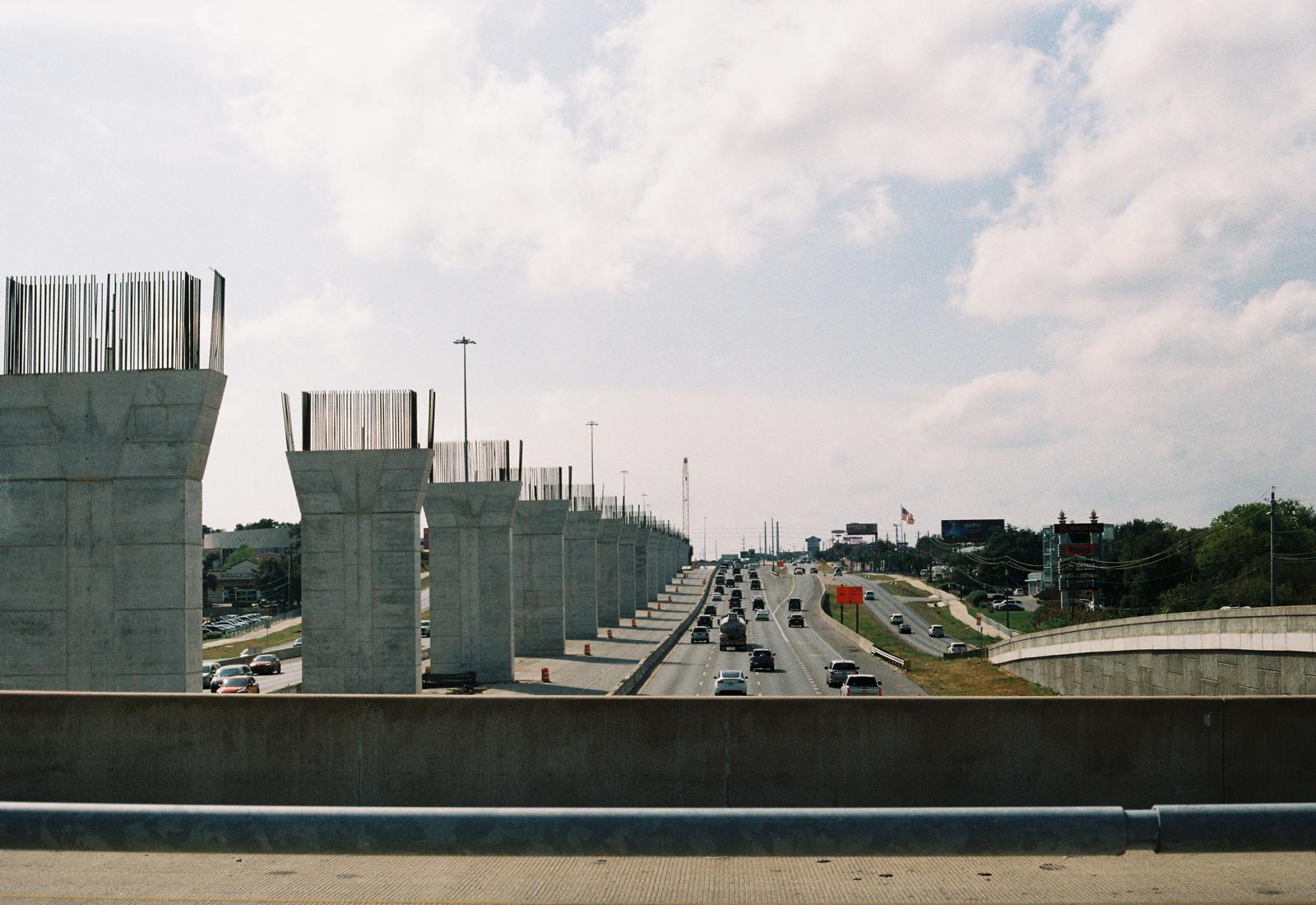
Turns out, in 1928, the city of Austin quite literally cemented segregation into its urban planning. Within two years, 80 percent of Austin’s African Americans were moved to the East Side. This wasn’t a natural trend and instead it was stimulated (forced) by moving institutions upon which Black Austonites depended towards the east, along with closing down schools and public facilities in other parts. In 1950, the city even built the I-35, a 3,500km highway that runs from Minnesota to Texas, right through the heart of Austin – physically separating the east from the rest of the city.
Highway 35, currently under construction to be widened.
At that same time, other parts of the city underwent transformative changes and priority was granted to preserve natural spaces in order to market the city as a beacon for green progress and growth. Meanwhile, polluting institutions like petroleum storage tanks and power plants were moved to the east side, of course. Whereas people on the western side of the highway lavishly enjoyed Austin’s unique natural water pools, people on the east developed acute and chronic health issues, cancers and diseases caused by pollution.
Visit Austin in 2024, and you’ll be told to explore the East side if you’re in search of a more alternative and off the beaten path experience. Sixth street, known for rollicking bars and trendy nightclubs hosting live music, is supposedly more eclectic, unique and authentically Austin once you cross that same, dividing highway. By now, East Austin has become one of the most gentrified neighborhoods in the city as the rising cost of living has pushed out the Black and Latino residents who have long called it home. As a result, trendy businesses and new developments have replaced long standing community establishments, ripping away at what made the east side so unique in the first place. At the same time, the west side is just a shell of once it once was, offering a commercialized bar experience worlds away from what used to make Austin’s Sixth street so special.
The Future of Austin’s Youth
Like most American cities, Austin struggles with increasing homelessness and rising levels of drug use. At the same time, big tech money is dominating the city’s changing landscape and steering much of the city’s economic growth. This trend gives shape to a certain disconnect between what the city experience can be like if you have money, and what it will realistically be like if you don’t.
Outside of a gas station on one of my last evenings in this city I met Josh, a twenty-one year old born and raised Austonite. Josh and I ended up talking for well over an hour and if I wasn’t for the fact that I had somewhere to be, we probably would have stood there well into the night. He was wearing a white shirt with more holes than I could count, a pair of black jogging shorts and some slippers. From under his right eyebrow, a deep scar ran across his face toward his ear. “Car accident”, he told me later, rubbing his finger across his eyebrow.
He struck up conversation with me as I was fumbling with my bike lock and asked whether I had ever gotten my bike stolen, a question that initially caught me off guard (and one I couldn’t quite answer on account of never having properly owned a bike in the U.S. at that point). He told me he simply asked because there are many people on the prowl for nice-looking bikes, to sell and buy drugs with. While telling me this, Josh pointed towards a pawn shop not much further from us, a decent enough looking business throughout the day that turned sketchy in the darker hours of the night. “Places like that, they’ll buy anything, even if they know it’s stolen”. We watched the flickering red pawn sign from afar and thought of all the stolen trinkets that could be on display right at this moment.
We were standing in South Austin, right off South Congress and a few minutes down from US-260, an east-west highway that runs from Houston through Austin, miles apart from the barn dance I would be attending less than an hour later and the farm that I had just left.
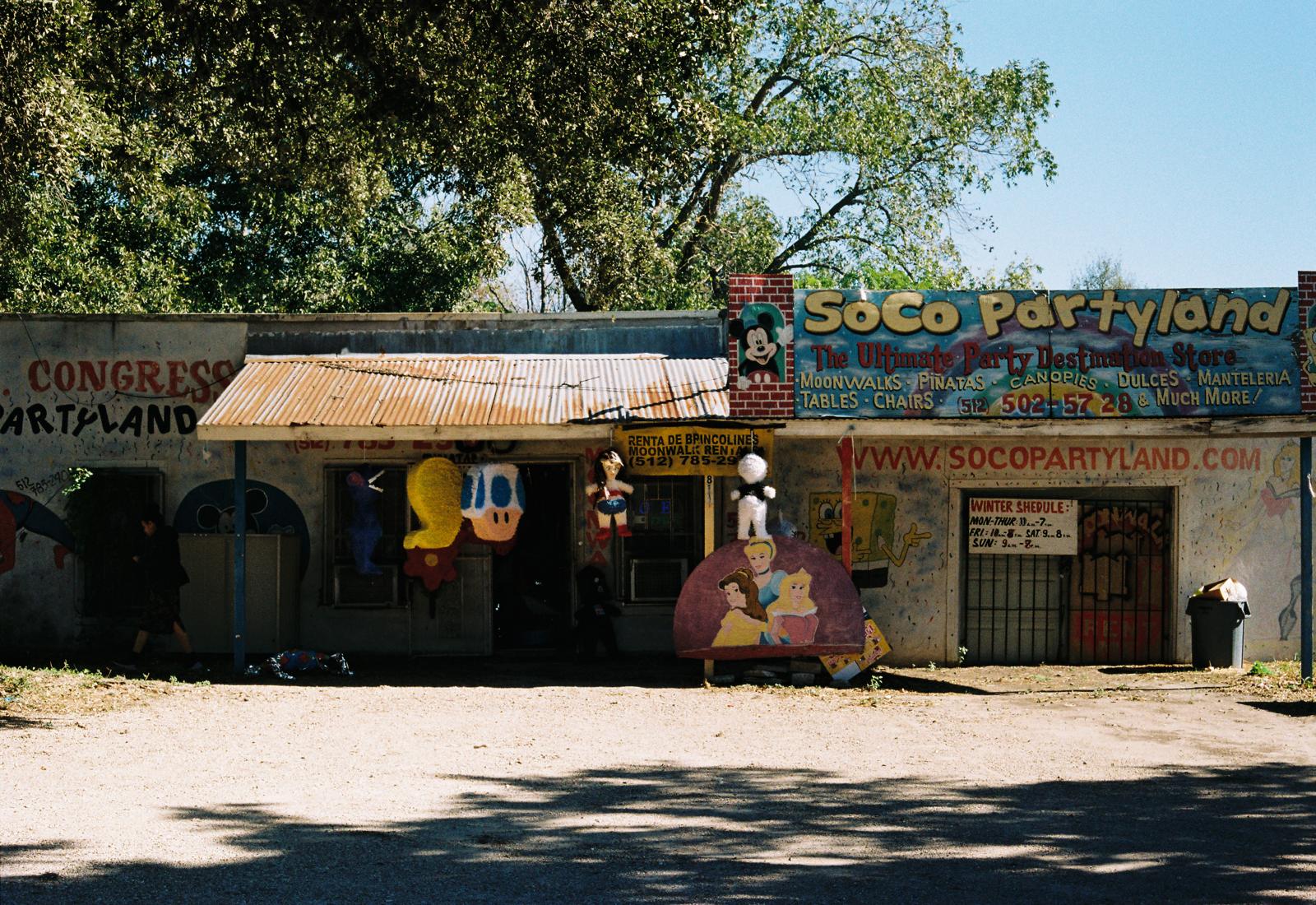
South Congress Av. hosts many random businesses, including this party goods and attire shop.
What followed was a conversation on Austin’s police presence, the cold stint in 2021 that sent Texas in a pure chaos, climate change, drug use in the U.S. (“Is fentanyl as big a deal in the Netherlands as it is here?” he asked), trash-lined highways, and the 24/7 economy that dominated much of American life. Despite being just twenty-one, he spoke with such an awareness of the world and the unfortunate reality in which he found himself that I genuinely would have sworn (or perhaps, wished) that he must have been older. I generally make this mistake more often, as youthfulness seems to be rushed in America.
He told me that he worked night shifts up at USPS (“Thankfully a labor union job”, he said, a fact he would have to hide when applying at future jobs as they are not generally keen on hiring individuals with labor standards) and slept through much of the day time. This alienated him from the Austin that existed throughout the day and the one that I had grown to know. Instead, his day to day consisted of continuously catching up on enough sleep to push himself through the night. “All that because it pays slightly more,” he confessed. And even then, he was just barely scraping by.
I would have loved to know more about his version of Austin – his go-to spots and his group of friends – but unfortunately it was time for me to move on. I did ask him if he felt like the city has changed over the years, although I realised later that he probably never even experienced the city prior to the tech-boom, the soaring housing prices, and the processes of gentrification taking over historically marginalised neighbourhoods. His answer? He simply told me that Austin would always be Austin, regardless of the changes taking place, as Austin is within the people who call it home.
I hope that he was right, and I also hope that those who have shaped and continue to shape this quirky and weird city can keep living in it, especially now that its future is becoming more uncertain due to the rising cost of living for all. And let’s not forget that with as un-Texan as this city might feel at times, it still lies within the heart of a big and dry Southern state, which also happens to be one of the U.S.’ fastest-warming states. Climate catastrophes like lasting droughts and extensive heats will affect all people evenly, regardless of your type of weird. But if there is a city best equipped with the identity markers needed to construct bridges between different types of people, it ought to be Austin. It has to be.
It wasn’t until my last day in New York City that I was told how to stay safe in the most populated city in the United States. At that point, I had already spent five days in upper Manhattan, taking the metro up and down at all times of the day (and night) and continuing to walk around with my head held up high even after the sun had sunk behind the buildings shooting up towards the sky. Additionally, I had spent another five days in Brooklyn, where one of my main activities had been to smile at random strangers and accept interactions wherever they arose, be it with a random Russian man on the beach in Coney Island, or an Albanian employee at an immersive art installation. It was because of that final reason that I suddenly found myself entangled in a conversation – although it was more of a one-sided lecture from her part – about safety in New York City.
I had just spent a couple of days walking around for eight hours a day, feeling unable to keep up with the growing list of things I still wanted to experience and see. On my last day, I had decided to venture out somewhat earlier than usual and make my way from Crown Heights in Brooklyn up to 34th Street in Manhattan to attend the biggest St. Patrick’s Parade in the world. Due to me naturally doing no prior research (I never learn), my expectations exceeded what I ultimately encountered and I quickly found the endless noise of countless bagpipes to become repetitive. For some reason, I had expected the parade to resemble carnival as we celebrate it in the Netherlands and had counted on seeing colourful floats, boisterous Irishmen and Americans alike, and, of course, a lot of Guinness spilled from cups on pavements, shirts and shoes. Nothing was less true and instead I was met with American families lining up behind the barricades that closed off a very large portion of Fifth Avenue, all collectively watching, smiling and clapping along as multiple Irish Associations make their way uptown surrounded by music. Signs like “Kick out the English” received even more clapping. Overall, the general atmosphere seemed to be positive, with over 12.9% of New Yorkers identifying with the Irish flags and banners that proudly waved in the wind – despite having lived in the U.S. all of their lives.
I later found out that the drinking kicks off towards the evening and mostly takes place in Irish pubs and clubs – but for me the fun unfortunately tends to end once festivities such as these move away from the streets into the indoors and so I saw very little of this. After ten minutes of trying to integrate among countrymen with whom I suddenly felt like I shared little cultural similarities, I began wondering: just what would be the best way to cross Fifth Avenue? I saw multiple food deliverers, all with fast black e-bikes decorated in flashy colours to visualize country flags to which they feel a connection, sported with loud speakers to keep them company and large wool mittens to warm their hands, wondering the same thing. I decided a good place to start would be to walk up to the finish point, expecting to find some sort of festival setting up there for paraders to come together and unite. On my way there, I was handed a personal manifesto documenting the truth behind JFK’s assassination (it begins: “I dreamt vehicle behind shot JFK”, which makes the most sense out of the entire text), somehow successfully revitalised my inner “walking-through-Amsterdam-during-the-weekend” energy (which very much consists of looking pissed off at anyone walking too slow for your liking) and left behind me the sound of bagpipes which still sleepily drifted in the air even three blocks down but was increasingly challenged by the sound of endless honking, revving engines, and New York City chatter.
I learned how to stay safe in this loud city from a woman who’d positioned herself along the parade around 70th Street with her husband and Cocker Spaniel named Clancy. After a month in the U.S., I had finally gotten over my irrational hesitation to ask people whether I could, please, pet their dog as at that point my missing of dogs, especially my own back at home, trumped the final shred of embarrassment I felt going up to random people. Besides, on St. Patrick’s Day everything felt possible, even without an ungodly amount of alcohol running through my veins. I first seized up the dog’s friendliness from afar, sneaking a picture to see how it responded to the attention. Within seconds, its tail swung beyond control and it began tugging at its owners’ leash – my cue to go up. I pointed toward the dog, a tiny bundle of excitement and friendliness I have truly only ever seen displayed in inner city dogs, and made a gesture that was meant to display my kindly asking permission. She nodded back, excitedly, but still refrained from any sort of further communication between us. Perhaps she was sizing me up too: a solo traveller with a dark green cap pulled over their eyebrows and wild strands of hair escaping from every side. Some Americans seem to be at all times stuck between wanting to be overly friendly, and lacking the general trust in others to do so. Indeed, almost 71% of the questioned Americans are less confident in each other than 20 years ago.
Within five seconds, her dog was making attempts to lick my face, doglike behaviour I will only really be able to bear from my own. Perhaps I passed the test, because within an additional five seconds, the owner began talking to me and telling me he could easily keep it up for as long as I would pet him (prompting me to stop petting him). I told her I was at all times surprised about how friendly NYC dogs are, a phrase I caught myself repeating with the next dog I pet (a three year old basset hound whose ears almost trailed the floor even when it sat upright). Like most Americans, and New Yorkers, this woman exuded a manner of immediate friendliness that will catch most Dutchies like myself off guard. I resisted from taking a step back when she touched my arm as I did not want to create a cultural barrier between us and instead chose to put up with the lack of personal space I suddenly found myself in. She asked if I had come here just for St. Patty’s, which once more made me realise this was a bigger thing than I made it out to be. I responded that I was Dutch and that no, I’d been solo travelling for a month – words that drifted in the air but failed to be caught by her even though we were only 10 centimeters apart (4 inches, for you Americans). She had somehow understood that I had only just arrived today, on the most perfect of days, if it were up to her to rank them. She told me she was a born and raised New Yorker but that she was fully, a 100%, genetically Irish, an identity marker she proudly carried within her and had no issue boldly stating either. Not just that, but even her dog was Irish, even though I am pretty sure he had never even touched Irish soil. Without asking, she began to tell me about how to stay safe in New York City.
She started off by saying that she had been assaulted three times in the past couple of years – a rate vastly exceeding the one that had pertained through her earlier years (do not quote me on this but I am guessing she must have been around 60 years old). She added that these men had not been out for money either – but for something else, the exact words unspoken but nestled in the tone with which she presented her experiences. She went on to say that the situation in the city has dramatically changed (for worse) due to the rising influx of immigrants making their way into a place that has no space nor resources for them. “They’re angry, these immigrants,” she said. I nodded, curious where this would go, “because they come here, expecting something better, but they find something worse.” I had also noticed how the expectations of a life in America was often far detached from reality. Even the people I had met who had succeeded in making their living here, pined to go back home one day – and it doesn’t take much to figure that having absolutely nothing can often have people act in the worst of ways. “If I can give you any tip, any tip, it would be this,” she started. I still had to push down the desire to take a step back as she gently pinched my arm to create some sort of fabricated connection between us. I imagined she was my grandmother to make it any easier, firmly planted my feet to the ground and even leaned in a little to show I was listening. Here goes, I thought. A New Yorker, giving me real New York City advice.
“First: when you walk alone, you keep your eyes planted to the floor”. I thought back to the fantastic things I had seen walking around the city at all moments of the day, seeing buskers on random street corners and in subway stations, catching glimpses of parents gently navigating their younger children through the busy streets in Brooklyn, watching a toddler spinning around certain metallic wheels that were not meant to be turned – let alone touch – and sharing a laugh about it with another passerby. I had learned that even in a city as big as New York, you could run into the same people twice (I swear, it happened, and I wouldn’t have noticed if I’d just looked to the ground). I also thought about all the things that we do begin to block out as time passes: the garbage riddled streets, the subway stations whose structures decay by mold and piss, my friendly smiles that went ignored, or worse, acknowledged and then ignored when walking through Williamsburg on my second day back in the city. I reflected on all the people slumped against walls in busy and calm streets alike, how they go unnoticed by the thousands of people passing them by every day because of this piece of advice – don’t look up. Ignore the despair of humanity when you’re faced with it.
“Second: when you take a subway, you don’t talk or interact with anyone.” I was instantly reminded of just a couple of hours ago when I had intentionally made a bit of a fool of myself to crack a smile from people around me (somehow so American, and incredibly embarrassing now that I reflect back on it). The subway was experiencing a power outage – a typical New York City experience I’d only ever heard about in tv shows like “Broad City” and one that I, despite the inconvenience, almost felt excited about. I hadn’t quite caught the stations between which the outrage occurred (Subway speakers are atrocious and I am incredibly impressed at the seasoned commuter who somehow manages to understand them) and so asked the couple seated in front of me to clarify it. The man told me it only affected the following three stations, which made me stand up immediately, announcing I might as well walk then. His partner gently nudged him and pointed out that it wasn’t the next three, but five stops that would be affected, to which I slumped back into my seat and jokingly waved away my earlier commitment to walking and thanked them for the heads-up. We shared a brief laugh about my apparent laziness. I thought about the thousands of interesting people you see in Subways every day, the “don’t be someone’s subway story” people, who unabashedly smoke joints, balance things on their heads, and do skateboard tricks. Or just those who are trying to catch a few seconds of sleep (people in NYC generally seem really, really tired), who have interesting conversations, read books or unbox their newest shoe purchase and patiently run the laces through them.
I was also reminded about the people using the busy commuters network to share their life stories about their steady decline into poverty (war veteran, unemployment, loss of housing, you name it) as an appeal for people to donate any spare chance they might have, and how any such story usually evoked the cruel response of people mindlessly going through the motions of yet another day. People would instantly stare down at their phones once such a story was passed on in a subway cart – and we’d all catch ourselves going quiet as conversations were dimmed and we listened to the life of another in complete silence but did absolutely nothing to fix it because what could we possibly do? There was a certain level of disconnect here, perhaps. In that moment, I felt as though we were all forced to face the undercurrents of our modern society, one of the many facets that have not worked out well, while at the same time many of us were reaping the benefits of th e same society. When looking around, you’d see shopping bags filled to the brim, expensive phones clenched tightly and designer shoes planted to the floor. For me personally, my entire being there was, in a way, a privilege not afforded by many. Maybe it is this complete detachment from one life to another that has resulted in a decay of human compassion. There is this belief that one dream can only really exist at the expense of another – there is no rich without the poor.
This isn’t just an American thing, by the way. Although it might be somewhat easier to start going blind to terrible situations in NYC, mostly due to there being so many, very similar trends are happening all over Europe – with migrants being washed ashore eliciting little real change being a prime example. Still, heartlessness, indifference, and callousness are not going to improve the world and perhaps we can only do better once we know, see and hear, where things are going wrong.
“Third: you never walk around Central Park as soon as dawn hits and you should always walk along the side of the street that has doormen,” which by the way is only really possible in richer neighborhoods as they are more likely to have doormen. Although she definitely had somewhat of a point here, with certain parts of Central Park being unsafe to walk through at night, especially as a young person and, despite my feigned level of confidence, still very much a tourist. But, I still couldn’t help but reflect on the fantastic park walk I’d done the day before. All the way up to the top by sunset, and back down again once the sky had turned all black and the New York City skyline simmered above me filled with a million lives that just kept on living. I thought of the couples, many of whom seemed to be queer, I had seen stroll around hand in hand as soon as the park had begun to settle down and darken. I thought of people unwinding on benches after long work days, stretching out on fields, throwing balls for their dogs to chase and groups smoking together so their laughs would echo over the water like a cascade of waves that just filled my heart with such joy.
She wrapped up her “life lessons for a tourist in NYC” as I am sure she would have categorized it herself by urging me to buy pepper spray and removing the safety cap every time I set foot outside. I thanked her because she genuinely had no bad intent in telling me any of this, despite knowing I had not and probably would not take her up on any of these points. On the contrary, I realised that her lived experiences, although I am sure valid, did not match my (albeit incredibly short) experiences. I personally couldn’t relate to the sense of general unsafety that seemed to riddle her body when walking around at night or alone, and if it were up to her I had been doing safety all wrong. I have been told over and over that NYC and the U.S. aren’t safe places to be. And although I have listened to these concerns and put them in practise more than once (I have crossed streets to evade strange situations and turned around once places would darken too much), I still could not help but shake the general feeling of safety and trust which I have had the privilege to foster during my childhood and early adult life in the Netherlands. I am not naturally wary of people and I do not assume the worst, and I have attempted to apply both of those feelings to most situations abroad. Of course, her reasons have to be grounded in some sort of lived reality (I doubt any fear can be completely ungrounded), but I did leave feeling just how unfortunate it is that some of us will live in the perpetual fear that inhibits us. It is a shame that we do not look around more, interact with our surroundings and the people around us. I am just one of billion, and there are billions more, and although being wary is important and unfortunately very necessary in the world we live in, there is a certain level of moderation we must all strive toward. She left off saying that, as bad as it is, there is unfortunately nothing we can do about “it”, being the current state of immigration policies in NYC that made her feel so unsafe. I pondered on this for a moment, initially agreeing as I too felt helpless and unable to change a system that has nestled its way into every fragment of society, but then began to realise that there are probably so many things we can do. Perhaps a good place to start, would be by looking up more.